Is AI search taking your small business's traffic?
AI answers roughly halve clicks on question searches, but customers ready to book still visit. How to check your own numbers and what to fix first.
6 min read
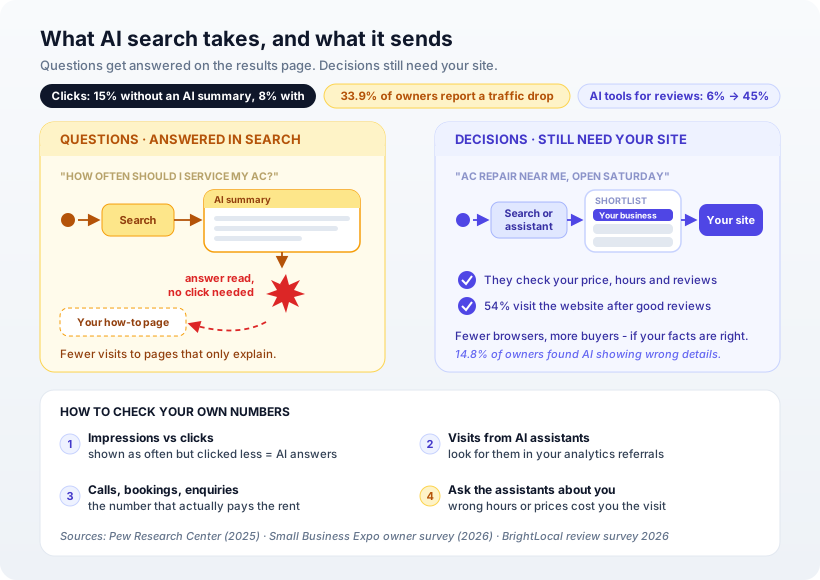
Partly. When a search shows an AI summary, people click through to a website about half as often - 8% of the time against 15% without one, in Pew Research Center's tracking of real browsing. That mostly hits pages that answer general questions. Searches from people ready to choose a business still end on a website, and AI assistants are becoming one of the ways those people find you. For a local business the real risk is less about lost visits and more about an assistant repeating the wrong hours or prices. You can check which of these is happening to you in about twenty minutes.
What the data says
Three sources, each measuring something different.
What people actually do. Pew Research Center tracked the browsing of 900 US adults in March 2025, covering 68,879 Google searches (Pew Research Center):
- 18% of those searches produced an AI summary.
- People clicked a normal result on 8% of visits to a page with a summary, against 15% without one.
- They clicked a link inside the summary itself just 1% of the time.
- They ended their browsing session after 26% of pages with a summary, against 16% without.
What owners believe. A Small Business Expo survey of 3,608 small business owners, published in September 2026, found that 33.9% had noticed a drop in website traffic they put down to AI answers (Small Business Expo). But 42.8% had noticed no drop, and 14.5% said they couldn't tell. The survey measures perception, and it says so: it doesn't show that AI caused the declines.
Where customers look. In BrightLocal's 2026 survey of 1,002 US consumers, the share using AI tools to read up on local businesses went from 6% to 45% in a year (BrightLocal). In the same survey, 54% said that after reading good reviews their next step is to visit the business's website - up from 32% in 2019.
Two kinds of search, two different outcomes
These numbers stop contradicting each other once you separate two kinds of search.
Questions. "How often should I service my AC?" "What's the difference between gel and acrylic nails?" An AI summary answers these on the results page. If part of your traffic came from articles like this, some of it has gone and won't return. Those visitors were rarely about to buy.
Decisions. "AC repair near me, open Saturday." "Eggless birthday cake delivery this weekend." Here the person needs to pick a business, and a summary can't finish that job. They still want to see the price, the hours, the reviews and a way to book. The assistant narrows the list; your site closes it.
AI search removes the browsers and keeps the buyers. That only hurts if your site was built for browsers.
So fewer visits doesn't automatically mean fewer customers. What matters is whether the visits you lost were the ones that turned into bookings.
How to check your own numbers
1. Compare impressions with clicks. Google Search Console is free and shows, for each search, how often your site appeared (impressions) and how often it was clicked. Look at the last three months against the same months a year ago. If impressions held steady but clicks fell, you are being shown and not clicked - the signature of AI answers. If both fell, the cause is something else, such as rankings.
2. Look for visits from AI assistants. Your analytics tool lists where visitors came from. Check the referral sources for AI assistants. The numbers will be small, but watch whether they are rising and whether those visitors make enquiries.
3. Count what pays the rent. Calls, bookings, form enquiries, orders. If these are steady while visits are down, you have lost readers, not customers.
4. Ask the assistants about your own business. Type "what are the opening hours for [your business]" and "how much does [your service] cost at [your business]" into two or three AI assistants. In the Small Business Expo survey, 14.8% of owners had found AI showing incorrect information about them, and another 34.4% didn't know either way. Among the owners who found errors, 56% also reported a traffic decline, against 31.1% of those who hadn't.
What to fix first
- Make the facts identical everywhere. Name, address, phone, hours and prices should match on your site, your business profile and your social pages. Assistants repeat whatever they find, and conflicting sources produce wrong answers.
- Put prices and hours on the page as text. Not inside an image or a PDF menu, where a machine can't read them reliably.
- Stop writing pages that only define things. Write what a summary can't supply: your prices, your area, your availability, your photos of real work.
- Keep reviews recent. They feed both the star rating people see and the summaries assistants write. We covered an honest way to do it in how to get more Google reviews.
The fuller method is in how to show up in AI search.
Our opinion
Much of the alarm about AI and traffic comes from publishers, whose income depends on page views. A plumber, a clinic or a bakery earns from bookings, and should measure those. We'd rather a client's site had 300 visitors a month who came to check a price than 3,000 who came to read a definition.
The part we'd take seriously is accuracy. An assistant that confidently tells a customer you're closed on Saturdays costs you a booking you'll never know about. That is worth an hour of checking every quarter.
How Ashvara helps
Our web development practice builds small-business sites so that both people and machines read the facts correctly: prices and hours as real text, structured data that states them unambiguously, and a booking or enquiry action on the first screen. We set up Search Console and analytics so you can run the four checks above yourself. The demo sites in our templates gallery show the approach, and our SEO and AI-search playbook explains it. Tell us about your business and we'll look at what the assistants currently say about you.
Sources: Pew Research Center - Google users and AI summaries (2025) · Small Business Expo owner survey (2026) · BrightLocal Local Consumer Review Survey 2026