How a small business earns backlinks without buying them
Bought links get ignored or penalised. Six places a small business can earn real ones - suppliers, associations, customers, local press - and what to avoid.
7 min read
A small business earns backlinks by giving real websites a real reason to mention it: being listed by its suppliers, its trade association and the customers it serves, getting covered by local press, and publishing one page useful enough to cite. Buying links does the opposite - Google's spam policies name it explicitly, and a bought link is ignored at best and a penalty at worst. You need far fewer links than the people selling them suggest, and the ones worth having bring customers as well as rankings.
What a backlink is, and why it still matters
A backlink is a link on someone else's website that points to yours. Search engines treat it as a vote: if a site people trust links to you, you're probably worth showing.
How much that vote counts has changed. Google's Gary Illyes said at a 2023 conference that links are no longer among the top three ranking signals (Search Engine Land). But "not top three" is a long way from "doesn't matter":
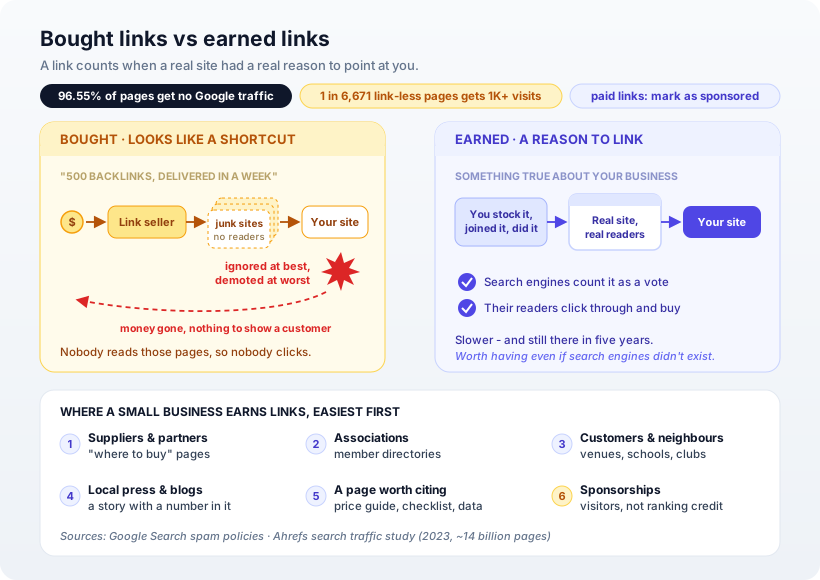
- Ahrefs analysed about 14 billion pages in 2023 and found that 96.55% of them get no traffic from Google at all (Ahrefs).
- In the same study, of roughly 20 million pages with no links from any other site, only 2,997 got more than 1,000 search visits a month. That's about 1 in 6,671.
- Pages with links from more sites got more traffic and ranked for more searches. The study is careful to call this a correlation, not proof of cause.
For a local business the practical reading is simple. You don't need hundreds of links. You need a handful from sites that are real, relevant and local - and most of your competitors down the road have none.
Why buying them backfires
Google's spam policies define link spam as "creating links to or from a site primarily for the purpose of manipulating search rankings", and the first example on the list is "buying or selling links for ranking purposes". Also on the list: excessive link exchanges, automated link-building services, and "low-quality directory or bookmark site links". The stated consequence is that sites "may rank lower in results or not appear in results at all" (Google Search Central).
In practice the more common outcome is quieter: the links are simply ignored, and you've paid for nothing. Either way there's a second problem. The sites that sell links have no readers. A link from a page nobody visits sends you nobody.
A link worth having is one you'd still want if search engines didn't exist - because the people reading that page are your customers.
Advertising is fine. Google's policy says paid placements aren't a violation as long as the link is marked with rel="sponsored" or rel="nofollow", which tells search engines not to count it as a vote. You still get the visitors.
Six places to earn real links, easiest first
1. Suppliers and partners. If you stock a brand, install a product or are certified by a manufacturer, they very likely have a "where to buy" or "find an installer" page. Ask to be on it. This is the easiest link most businesses never ask for.
2. Trade associations and chambers of commerce. Member directories on these sites are exactly the kind of link search engines trust: relevant, vetted, and hard to fake. If you already pay the membership fee, make sure your listing has your website on it.
3. Customers and neighbours. A caterer can be listed on the venues they work with. A tutor can be on a school's resources page. A photographer can be credited by the planner whose wedding they shot. Wherever you already do good work for another organisation, a mention is a reasonable ask.
4. Local press and community blogs. Local reporters need stories. Give them one with a number in it: the bakery that switched to fully eggless and what happened to sales, the clinic that cut waiting times in half, your tenth anniversary and the 4,000 customers served. A story with a fact is printable; an announcement isn't.
5. One page worth citing. Publish the thing people in your town keep asking: a plain price guide, a "what to check before you hire a..." checklist, a seasonal calendar. Other sites link to useful reference pages for years. This is also what AI assistants quote - we covered that in how to show up in AI search.
6. Sponsorships. Sponsoring a school event or a local sports team usually gets you a link on their site. Under Google's policy that's a paid link, so it should be marked sponsored and won't pass ranking credit. Do it for the goodwill and the visitors, not the ranking.
Profiles on Google, social networks and review sites are worth completing too. Their links mostly don't pass ranking credit, but they help search engines confirm you're a real business with a consistent name, address and phone number.
What to avoid
- "500 backlinks for $50" packages and anything delivered by the hundred.
- Link swaps arranged purely to trade links - "you link to me and I'll link to you".
- Bulk directory submission services. One listing in a directory your customers actually use is good. Three hundred in directories nobody has heard of is the pattern Google names.
- The same keyword-stuffed link in the footer of many sites. "Widely distributed links in the footers or templates of various sites" is on Google's list.
- Paying for a "guest post" on a site that publishes anything from anyone.
Our opinion
Most link-building advice is written for companies with a marketing team. A small business doesn't need a campaign. It needs one afternoon: list every organisation you already have a real relationship with - suppliers, associations, venues, schools, clubs, the local paper - and ask each one for a mention. Five or six of those will do more than any package you can buy, and they compound, because they sit on sites that will still exist in five years.
It only works if the link has somewhere good to land. A link to a slow page with no prices and no way to book is a wasted introduction - which is why we'd fix the site first. If you're still deciding whether you need one, start with does a small business need a website?.
How Ashvara helps
We build the site the links point to. Our web development practice makes it fast, puts the customer's main action on the first screen, and adds the structured data that helps search engines and AI assistants read it correctly; our SEO and AI-search playbook explains the approach. You can click through working demo sites for 16 kinds of business to see what that looks like. Tell us about your business and we'll tell you honestly where your first five links should come from.
Sources: Google Search Central - spam policies · Ahrefs search traffic study (2023) · Search Engine Land on Gary Illyes's remarks (2023)