What a small business website needs in 2026, by industry
Every visitor arrives with one job. Here's the must-have list for restaurants, clinics, salons, coaching, real estate, studios, home services and accountants.
8 min read
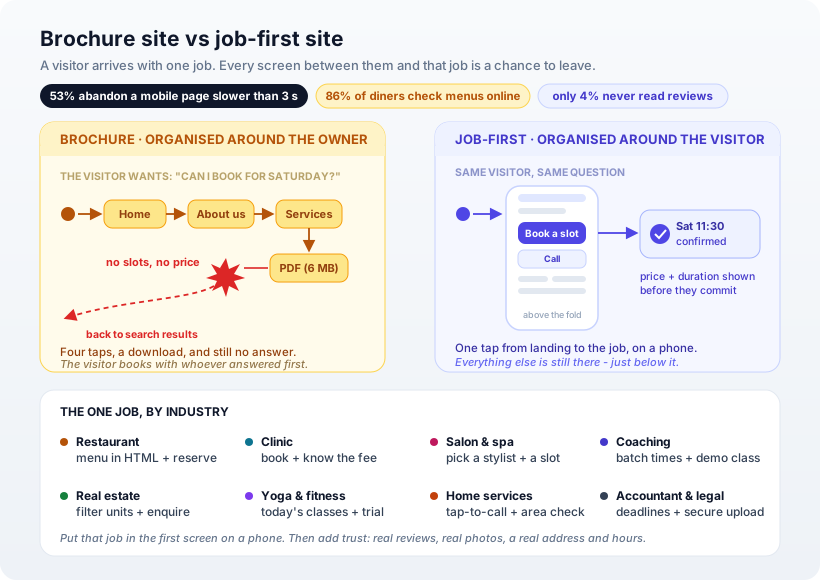
A small business website needs exactly one thing above everything else: the visitor's job, done in one tap on a phone - book the table, see the fee, call the plumber - followed by enough proof (reviews, real photos, address and hours) to trust you with it. Everything else on the site is supporting material. The job is different for every industry, which is why a generic template organised around "Home, About, Services, Contact" so often underperforms.
Why "one job" is the whole game
Small-business visitors don't browse. They arrive from a search or a map with a specific question, usually on a phone, and they leave the moment answering it gets hard. The numbers are blunt:
- Speed is the first filter. Google's mobile speed research found that 53% of mobile site visits are abandoned if a page takes longer than three seconds to load (Google, "The Need for Mobile Speed"). The study is from 2016; expectations have only tightened since.
- People check before they come. In OpenTable's survey of more than 6,000 diners, 86% said they regularly check menus online before dining out (OpenTable). A 2019 MGH survey found 77% of diners are likely to visit a restaurant's website first - and nearly 70% said a restaurant's website had put them off visiting (PR Newswire).
- Trust is checked, not assumed. BrightLocal's 2025 Local Consumer Review Survey found that only 4% of consumers never read online reviews of local businesses (BrightLocal).
- Booking online is expected, but not by everyone. A Zion & Zion survey of 1,049 consumers found 45% would rather book a healthcare appointment online than by phone - rising to 55% of 18-29 year olds and falling to 32% of those over 60 (Zion & Zion via BioSpace).
That last one matters: the right answer is rarely "online only". It's online booking and a phone number you can tap, both on the first screen.
A website loses customers in two places: before it loads, and before it answers the one question the visitor came with.
The base layer every business needs
Before the industry-specific parts, these are non-negotiable for any local business:
- The primary action on the first phone screen - a booking button, a tap-to-call number, or a quote form. Not in a hamburger menu.
- Loads in under ~2.5 seconds on a mid-range phone. That's Google's "good" bar for Largest Contentful Paint, and it rules out autoplay video heroes and 6 MB PDFs. We wrote up what makes a website fast separately.
- Real proof - genuine reviews, photos of your actual premises and people, and an address, hours and map that match your Google Business Profile exactly.
- Text, not images of text. Menus, price lists and timetables as real HTML so they're readable on a phone, searchable by Google and quotable by AI assistants.
- Structured data (LocalBusiness, FAQ, opening hours) so search engines understand what you are without guessing.
Industry by industry: the one job and what supports it
Each line links to a working demo we built for that industry, so you can click through the flow instead of imagining it.
- Restaurant & café - the job is "what's on the menu and can I get a table?" Put the menu in HTML with dietary tags (vegetarian, Jain, gluten-free) and a reservation or order button above the fold. Your own ordering page also keeps the margin a third-party platform would take.
- Dental & medical clinic - "can I see someone soon, and what will it cost?" Plain-language treatment pages with fee ranges, doctor profiles with real photos, and booking with reminders. Reminders reduce no-shows, which is money the clinic was already losing.
- Salon & spa - "can my stylist do Saturday?" Booking by stylist and service, with duration and price shown before confirming, plus a lookbook of real work.
- Coaching institute - "which batch fits my schedule, and is it any good?" Batch timings, fees, a free demo-class sign-up, and results that are verifiable rather than vague.
- Real estate & builders - "which units fit my budget?" Filters for budget, bedrooms and status, a page per unit with floor plan and registration numbers, and an enquiry that captures which unit they were looking at.
- Yoga & fitness studio - "what's on today and can I try it?" A live class schedule, a trial-class booking, and memberships explained in one table.
- HVAC & home services - "can you come today, to my area?" Tap-to-call in the header on every page, a service-area checker, and a quote request that asks for a photo of the problem.
- Accountant, law & notary - "can you handle my deadline, safely?" A deadline calendar, clear service packages, and a secure document upload so clients never have to email tax papers.
- Bakery & cake shop - "what's fresh today, and can I order a cake for Sunday?" A daily bake list that's actually current, dietary labels (eggless, vegan, Jain) on every item, and a cake order flow with pickup slots and a deposit.
- Physiotherapy clinic - "do you treat my problem, and when can I come in?" Condition pages organised by where it hurts, booking by therapist and visit type, and a home exercise plan patients can follow on their phone.
- Photographer - "are you free on our date?" A fast full-screen portfolio grouped by shoot type, packages laid out side by side, and a date checker that lets clients hold a date themselves.
- Interior designer - "can you do a project like mine, at my budget?" Projects told with the brief and the transformation, the process in clear stages, and an enquiry that captures rooms, timeline and budget range.
- Wedding planner - "can you plan a wedding like ours, and roughly what will it cost?" Real weddings told event by event, clear service levels, and a budget estimator that responds to guest count and style.
- Boutique & clothing store - "will it fit, and can I try it on?" Collections styled the way you'd lay out the store, a size finder based on real measurements, and reserve-in-store.
- Homestay & guesthouse - "is it free on our dates, and what's the total?" Direct booking with live room availability and the full price, plus the meals, directions and house rules guests always ask about.
- Private tutoring - "who can help my child with this subject, and when can we start?" A matcher by subject, grade and goal, a free trial lesson, and progress notes for parents after every session.
The mistakes we see most
- A slideshow hero that pushes the action below the fold and adds seconds of load time.
- PDF menus and price lists - unreadable on a phone, invisible to search.
- The phone number only in the footer, or as an image that can't be tapped.
- Stock photos of people who don't work there. Visitors notice, and it costs trust that real reviews just earned you.
- Contact forms that ask for ten fields when name, phone and "what do you need?" would do.
Our opinion
Most small-business websites are designed around the owner's view of the business - our history, our values, our services - because that's what the owner thinks about all day. The visitor doesn't care yet. Design the first screen around their question, prove you're real just below it, and put the history further down where the people who want it will find it. A site built this way does more for a local business than any amount of keyword stuffing, because every ranking signal that matters for local search - speed, engagement, structured data, reviews - follows from it.
How Ashvara helps
We build fast, job-first websites end to end, and we've published working website templates for each industry above - plus bakeries, physiotherapy clinics, photographers, interior designers, wedding planners, boutiques, homestays and tutors - so you can see exactly what you'd get and preview it with your own name and colours before anything is built. If your business doesn't fit one of them, that's normal; they're starting points. Our web development practice covers the build, the structured data and the hand-over, and we built ashvara.io itself the same way. Tell us about your business and we'll show you what we'd build first.
Sources: Google mobile speed study (2016) · OpenTable diner research · MGH restaurant website survey (2019) · BrightLocal Local Consumer Review Survey 2025 · Zion & Zion healthcare booking study