How to cut no-shows: reminders, deposits and online booking
Text reminders are the best-proven fix for no-shows; deposits help on long slots but the evidence is thinner. What to set up first, and why.
6 min read
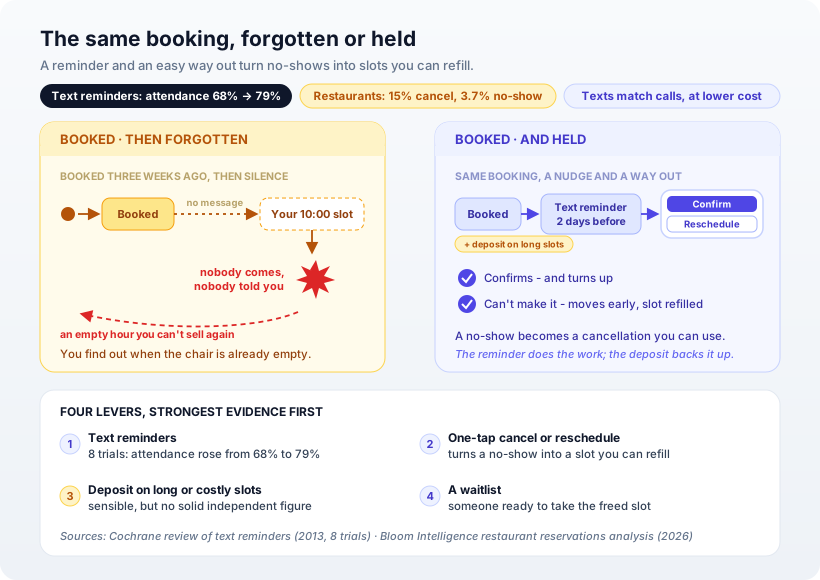
The best-proven way to cut no-shows is a text reminder a day or two before the appointment, with a one-tap way to confirm or reschedule. In a Cochrane review of eight randomised trials, text reminders lifted attendance from about 68% to about 79%. Deposits are worth adding for long or expensive slots, but the big percentages you see quoted for them come from the companies that sell booking software, not from independent studies. So set up reminders first, make cancelling easy second, and use deposits where an empty slot really hurts.
What the evidence actually says
Search for no-show statistics and you'll find dozens of confident numbers. Most trace back to a booking-software company's blog, and they contradict each other. We went looking for sources that don't have something to sell.
Reminders have real trials behind them. The strongest evidence is a Cochrane systematic review - the kind of study that pools randomised trials and grades how reliable they are. It covered eight trials and 6,615 people with healthcare appointments (Cochrane review, 2013):
- With no reminder, about 68% of people attended. With a text reminder, about 79% did.
- Text reminders worked as well as phone calls - roughly 79% against 80% attendance.
- In the two trials that measured cost, a text reminder cost 55% and 65% as much per attended appointment as a phone call.
The reviewers rated the evidence as moderate quality, and these were clinic appointments, not salon or studio bookings. But the reason it works - people forget, and a nudge reminds them - is not specific to clinics.
Deposits have vendor claims, not trials. We could not find an independent, peer-reviewed study that measures how much a deposit reduces no-shows for an ordinary service business. That doesn't mean deposits don't work. It means anyone who quotes you a precise percentage is passing along marketing.
Cancellations are the bigger number. One restaurant-marketing company published an analysis of hundreds of thousands of reservations across about 50 restaurant locations (Bloom Intelligence, 2026). It is a vendor's own data from a narrow sample, so treat it as a rough guide. It found a 3.7% no-show rate and a 15% cancellation rate - four cancellations for every no-show. It also found that online bookings were missed slightly more often than phone bookings (3.9% against 3.0%), and that tables for one or two were missed more than twice as often as large groups (4.5% against 1.8%).
Why these numbers point to the same fix
Put those together and a pattern shows up. A booking is easy to forget when it took ten seconds to make, when it's small, and when it was made weeks ago. Nobody spoke to a person, nothing was paid, and nothing has reminded them since.
A no-show is usually a cancellation that never got the chance to happen.
That reframes the job. You are not trying to punish people who don't turn up. You are trying to find out early, while the slot can still be given to someone else. A customer who taps "reschedule" two days ahead has cost you nothing.
What to set up, in order
1. A text reminder with two buttons. Send it one or two days before, not an hour before - you need time to refill the slot. Include the time, the place, and two choices: confirm or reschedule. Most booking systems can do this automatically.
2. Cancelling and rescheduling without a phone call. If the only way to cancel is to ring during opening hours, many people will simply not come. A link in the confirmation message removes the awkwardness that causes a lot of no-shows.
3. A deposit, but only where it earns its place. Deposits make sense when one missed booking is expensive: a three-hour colour appointment, a custom cake order, a photography session, a table for twelve. For a quick, low-value slot, a deposit mostly adds a step that puts off new customers. If you take one, say clearly when it's refundable and take it off the final bill.
4. A waitlist. An early cancellation only helps if someone can take the slot. Even a simple list of people who asked for an earlier time, messaged in order, recovers a good share of them.
5. Count before and after. Write down how many bookings were missed last month. Turn on reminders, then count again. Your own numbers are worth more than any benchmark, including the ones in this article.
Our opinion
Deposits get the attention because they feel like protection, and the software companies promote them because payments are how they earn. But the order matters. A business that adds a deposit without reminders is charging people for forgetting. A business that adds reminders and easy rescheduling first often finds it only needs deposits on its two or three longest services.
We'd also resist the urge to fine people after the fact. Chasing a no-show fee from someone who has already decided not to come back rarely recovers the money and always costs the relationship.
How Ashvara helps
Online booking is part of the small-business sites we build through our web development practice: a booking page that loads fast on a phone, automatic confirmation and reminder messages with confirm and reschedule links, and optional deposits on the services you choose. Several of the demo sites in our templates gallery show a booking flow you can click through. If you're still deciding whether a site is worth it, does a small business need a website? covers that first. Tell us how your bookings work today and we'll tell you which of these would make the biggest difference.
Sources: Gurol-Urganci et al., "Mobile phone messaging reminders for attendance at healthcare appointments", Cochrane Database of Systematic Reviews (2013) · Bloom Intelligence restaurant reservations analysis (2026)