Boutique & Clothing Store Website Design
A shop that feels like your store, sizing people can trust, and the option to reserve a piece and try it on in person.
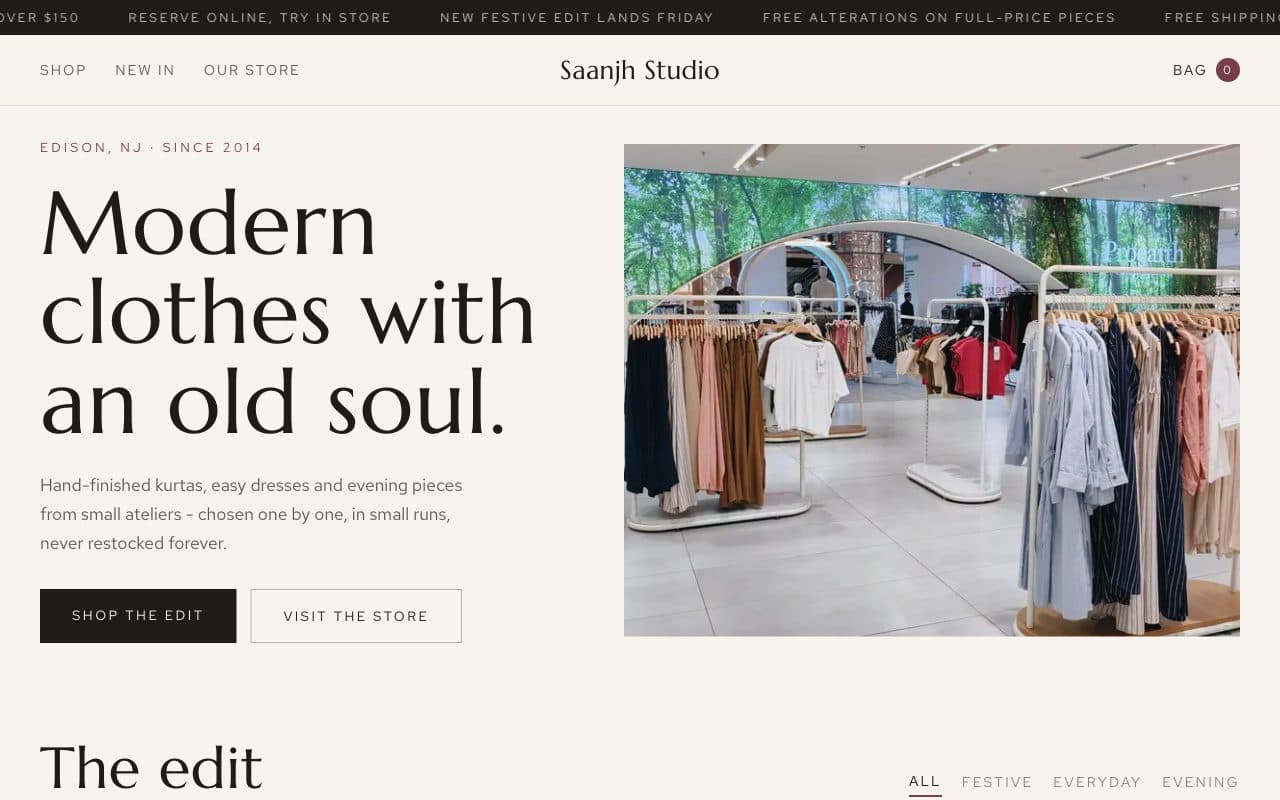
Saanjh Studio is a fictional business. We adapt the language, payments and details to wherever you work.
Independent boutiques sell on curation and personal service. This template brings both online: collections arranged the way you'd style them in-store, product pages with real fit notes and a size guide that asks for measurements instead of guessing, and a reserve-in-store option for customers who want to try before they buy. New arrivals get their own drop page, so regulars know when to look.
Try each of these in the demo.
Collections, styled
Shop by edit - festive, everyday, workwear - the way you'd lay out the store.
Sizing people trust
A size finder that uses real measurements and your fit notes, so fewer pieces come back.
Reserve and try in store
Hold a piece for 48 hours and try it on before buying - online browsing, in-store sale.
New-arrival drops
A drop page and sign-up, so regulars know the moment new pieces land.
A complete site, built for you.
Designed around your brand and photos, written with you, fast on any phone, and yours to own.
- ✓Home
- ✓Shop
- ✓Collections
- ✓New arrivals
- ✓Size guide
- ✓Our store
- ✓Shipping & returns
- ✓Online store & checkout
- ✓Reserve in store
- ✓Size finder
- ✓Email & WhatsApp drop alerts
- ✓Search-ready structure & schema
- ✓Analytics from day one
What every boutique website needs
A boutique competes on taste and service, not on catalogue size. The website should feel like walking into your store - curated, personal and easy - while making buying online feel safe.
- 01
Collections that reflect your curation
Edits by occasion and mood, not just categories. It's how customers shop with you in person, and it shows your eye.
- 02
Product pages with real detail
Several photos on a person, fabric and care, and honest fit notes like 'runs small, size up'. Detail is what makes people comfortable buying without touching the fabric.
- 03
A size guide that asks, not guesses
A size finder based on the customer's measurements and your own size chart. Fit is the biggest reason clothes are returned, so this protects your margin.
- 04
Reserve in store
Let customers hold a piece and try it on. Many shoppers browse online and buy in person, and this captures that visit.
- 05
New-arrival drops
A dedicated page and an email or WhatsApp sign-up for new stock. Regulars come back when they know something new has arrived.
- 06
Clear shipping and returns
Costs, delivery times and the return window stated plainly on every product page. Uncertainty here causes abandoned carts.
Mistakes we design out.
Flat-lay photos only
Clothes look different on a person. Every product has on-body photos and a note on the model's size.
A generic size chart
Sizing varies by label and cut. We use your measurements and fit notes, not a copied chart.
Hiding the shipping cost until checkout
Surprise costs are a leading reason people abandon carts. Shipping is shown early and clearly.
What you'll need to send us.
Nothing needs to be perfect. Send what you have and we'll help shape the rest.
- ✓Product photos, ideally on a model
- ✓Prices, sizes, fabrics and care details
- ✓Your size chart and fit notes
- ✓Shipping rates and return policy
- ✓Store address, hours and photos
- ✓Your collections or edits
Questions, answered.
Can customers reserve items to try in store?
Yes. Customers choose a size and reserve a piece for 48 hours; you get a notification and set it aside.
How does the size finder work?
Customers enter a few measurements and see the recommended size for each piece, based on your size chart and fit notes.
Can we sell online and in store from the same stock?
Yes. Inventory can sync with your point of sale, so items sold in store disappear from the website.
Can we announce new arrivals?
Yes. A new-arrivals page and an email or WhatsApp sign-up let regulars know when new pieces land.
Can we offer local pickup?
Yes. Customers can choose free in-store pickup at checkout.
How long does it take?
Usually four to six weeks, depending on how many products we load.
Further reading: what a small business website needs, by industry →