Passkeys are the default now: killing the password in 2026
Passkeys hit ~5 billion in use and a 93% login-success rate vs 63% for passwords. Here's the mechanism, the real numbers, and when to add them.
5 min read
Passkeys crossed the line from "promising" to "default" in 2026, and the reason is simple: they delete the shared secret that every password attack depends on, and they measurably beat passwords on the numbers businesses actually care about - roughly a 93% login-success rate versus about 63% for passwords. This isn't a security-team nicety anymore; it's a conversion and support-cost story with a phishing-resistance bonus. If you run a product with a login screen, passkeys are now the thing you add, and the only real question is how you roll them out alongside the passwords you can't rip out overnight.
Why this matters now
The adoption curve stopped being theoretical. The FIDO Alliance's State of Passkeys 2026 reports roughly 5 billion passkeys now in active use, 90% consumer awareness, and 75% of people having enabled a passkey on at least one account. Around 48% of the world's top 100 websites now support passkeys - more than double the 2022 figure - and 87% of US and UK companies have deployed or are actively deploying them.
The performance gap is what makes it a business decision, not just a security one:
- ~93% login success with passkeys vs ~63% with traditional methods. Google separately reports its passkey sign-ins are about four times more successful than passwords.
- Organizations deploying passkeys see, on average, a 73% reduction in sign-in time and an 81% reduction in login-related support tickets.
- Scale is already there: Google reports over 800 million accounts using passkeys, and more than 15 billion accounts across the industry can now sign in with one.
Every failed login is an abandoned cart or a churned signup, and every password reset is a support ticket. Passkeys move both numbers in your favor at once.
The mechanism: no shared secret to steal
Here's why passkeys are structurally safer, not just newer. A password is a secret both parties know: you type it, it travels over the wire, and the server stores a copy. Every weakness follows from that - it can be phished on a fake page, reused across sites, and dumped in a breach.
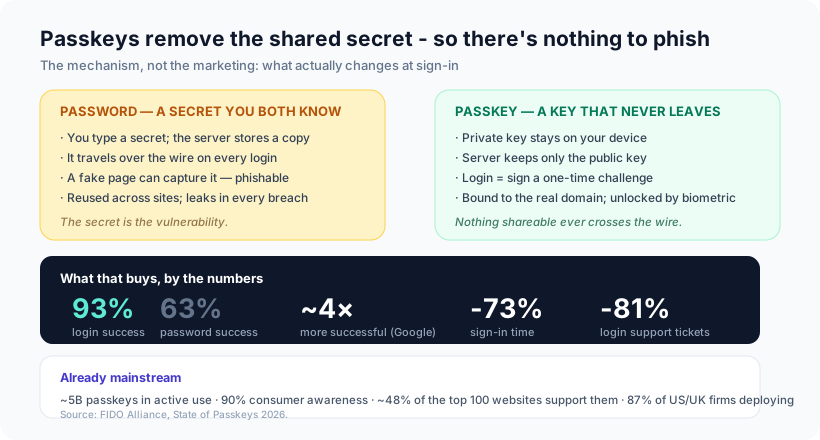
A passkey is a public/private key pair. The private key is generated on your device and never leaves it; the server only ever holds the matching public key. Signing in means the server sends a one-time challenge, your device signs it with the private key (unlocked by your fingerprint or face), and the server verifies the signature with the public key. Three consequences fall out of that design:
- Nothing shareable crosses the wire. There's no secret to intercept, and the server's database has no password to leak - only useless public keys.
- It's bound to the real domain. The browser only offers the passkey to the site that created it, so a look-alike phishing page gets nothing. This is the property passwords can never have.
- The biometric stays local. Your fingerprint or face unlocks the key on-device; it isn't sent anywhere.
A password is a secret you share with a server and hope nobody else gets. A passkey is a secret your device never shares with anyone - including the server. You can't phish, reuse, or breach-dump a secret that was never handed over.
The honest caveats
Passkeys are the right default, but a responsible rollout accounts for the rough edges:
- You can't delete passwords on day one. Most organizations run both in parallel; the reality is a transition, and 57% of organizations still rely on phishable authentication for primary sign-in. Offer passkeys as the preferred path, keep a fallback, and nudge users over time.
- Account recovery is the hard part. "Something you have" needs a real recovery story for a lost device - synced passkeys (via the platform's cloud keychain) help a lot, but you still design for the edge cases.
- UX drives adoption. The gap between a product where 5% of users enable passkeys and one where 80% do is almost entirely prompt timing and clear copy, not the underlying tech.
Our opinion
Our view: add passkeys now, as the preferred option, and treat the password as the legacy fallback you're actively shrinking - not the other way around. The evidence is one-sided enough that waiting mostly means leaving conversion and support savings on the table. The 93%-vs-63% success gap alone justifies the work for most consumer products before you even count the phishing resistance.
The one place we'd push back on the hype: passkeys are not a weekend feature you bolt on and forget. The value is real, but so are the recovery flows and the parallel-auth period, and a rollout that ignores them creates locked-out users - which is its own kind of churn. Done properly, passkeys are one of the rare changes that make a product more secure and easier to use at the same time, which is exactly why we think they belong on the roadmap rather than the "someday" list. It's the same principle behind keeping sensitive data on-device: the safest secret is the one you never have to hold.
How Ashvara helps
We build web apps with authentication done right, and passkeys are squarely in that lane: adding them as the preferred sign-in, keeping a sane password fallback during the transition, designing the recovery flows so nobody gets locked out, and getting the prompt UX right so adoption actually happens instead of stalling at 5%. The goal is the measurable win - higher login success, fewer support tickets, real phishing resistance - not a half-finished passwordless feature.
If you want passkeys added to your product without the lockout landmines, that's our web development work. Talk to us and we'll help you kill the password without breaking sign-in.
Source: FIDO Alliance - State of Passkeys 2026 / Passkey Index (~5B passkeys in use, 93% vs 63% login success, 73% faster sign-in, 81% fewer login support tickets).