Does a small business need a website if it has Google and Instagram?
Yes. Profiles get you found; a website is where customers check prices, book and decide. What each one is for, with the numbers.
7 min read
Yes - a small business still needs its own website, even with a complete Google Business Profile and an active Instagram page. The profiles are where customers find you; the website is where they check the price, book, and decide to trust you. Without it, the profile has nowhere to send them. The good news is that the website this calls for is small: a few fast pages built around the one thing your customers come to do.
Why owners ask this now
It's a fair question. A Google Business Profile is free and shows your hours, phone number, photos and reviews right in the search results. Instagram is where a lot of customers first see your work. Both take an afternoon to set up, and a website costs money. So why bother?
Because customers still go looking for the website, and they judge you when it's missing:
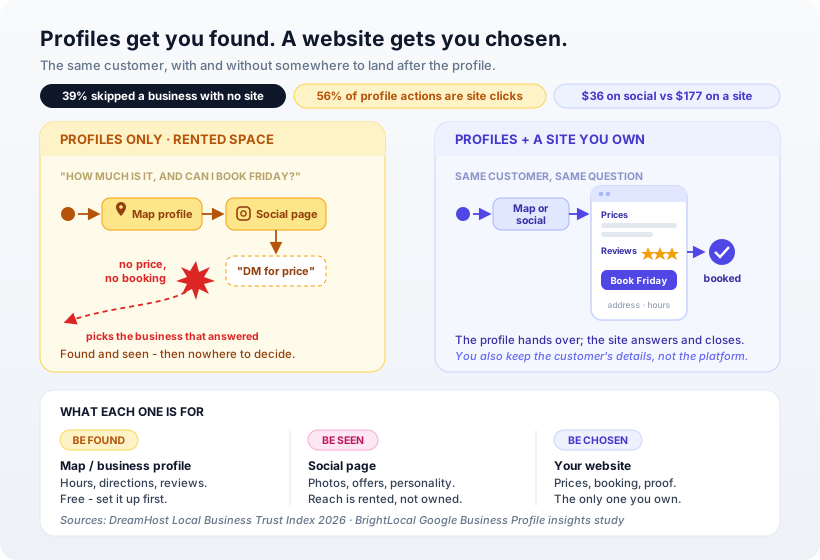
- Four in ten have walked away. In DreamHost's 2026 Local Business Trust Index, a survey of 1,201 US consumers, 39% said they had decided not to visit or buy from a business because it had no website - 45% among 18-44 year olds. 69% called a website essential for credibility, second only to online reviews at 74% (DreamHost). The survey comes from a company that sells hosting, so read it with that in mind; the direction matches what we see with clients.
- The profile's main job is to send people to your site. BrightLocal studied 45,264 local business listings and found that 56% of all the actions people took on a listing were clicks through to the website - more than calls and direction requests combined (BrightLocal). The data is from 2017-18, but the profile still has the same three buttons.
- People spend less where they trust less. The same DreamHost survey asked how much people are comfortable spending with a business they found each way: an average of $36 through a social media shop against $177 on the business's own website. A third said they'd spend nothing at all through social.
- Followers mostly don't see your posts. Socialinsider's benchmark of 67 million posts from 579,000 brand accounts puts the average Instagram engagement rate at 0.48% of followers in 2025, down from 0.50% the year before (Socialinsider). A page with 2,000 followers gets likes and comments from about ten of them per post.
A profile answers "does this business exist?" A website answers "should I pick this one?" Customers ask both, in that order.
What each one is actually for
They aren't competing. Each does one job well and the others badly.
| Business profile on Google | Instagram page | Your own website | |
|---|---|---|---|
| Job | Be found | Be seen | Be chosen |
| Best at | Hours, directions, reviews, tap-to-call | Photos of your work, offers, personality | Prices, booking, menus, proof, detail |
| Weak at | Anything longer than a line | Being searched; posts vanish in a day | Being discovered on its own |
| Who controls it | The platform | The platform | You |
| Cost | Free | Free, plus your time | A one-time build plus hosting |
The row that matters most is control. A profile can be suspended, a feature can be removed, and an algorithm change can halve your reach with no warning and nobody to call. Your own domain is the only place where the customer list, the booking flow and the content belong to you. That's also what search engines and AI assistants read when someone asks for a recommendation - in the DreamHost survey, only 35% said they'd consider a business an AI assistant recommended if it had no website.
Where the customer falls through
Follow one customer. They search "eggless birthday cake near me" on a Saturday morning. Your profile shows up with good reviews. They tap it. Now they have a question the profile can't answer: how much is a 1 kg cake, and can I collect it tomorrow?
With no website, their options are to call (you're busy with the morning rush), message you on Instagram (you'll reply in three hours), or go back and tap the next bakery - the one whose site shows flavours, prices and a pickup slot. They aren't choosing the better cake. They're choosing the business that answered.
This is the mechanism behind the 39%. Businesses without a site don't lose because customers think less of them. They lose because the question went unanswered at the moment the customer was ready to buy.
When you can genuinely wait
Not every business needs a site on day one. You can lean on profiles alone for a while if all of these are true:
- You sell one simple thing at one price, and everyone already knows what it costs.
- Nearly all your customers come from word of mouth or walk past your door.
- You're fully booked and not trying to grow.
If any of those stops being true - you add services, raise prices, open a second location, or have a quiet month - the website is the first thing to fix.
What the site needs (it's less than you think)
A small business doesn't need twenty pages. It needs:
- The main action on the first screen of a phone - book, order, call, or request a quote.
- Prices or price ranges in real text, not a photo of a menu.
- Proof - real reviews, photos of your actual work, and an address and hours that match your Google profile exactly.
- Speed. Under about 2.5 seconds on an ordinary phone.
We've written up what a small business website needs, industry by industry, and what a website costs in 2026 if you want numbers before you talk to anyone.
Our opinion
Set up the Google profile first - it's free, it takes an hour, and it's the single highest-return thing a local business can do online. Then build the smallest website that answers your customers' top question and lets them act on it. Treat Instagram as the shop window, not the shop: post your work there and send people to the site to book or buy. The businesses we see struggle are the ones that put years of effort into a social page and then discover they own none of it.
How Ashvara helps
We build small, fast, job-first websites end to end. To make that concrete, we've published working demo sites for 16 kinds of business - bakeries, clinics, salons, photographers, tutors, homestays and more - where you can click through the booking or ordering flow and preview it with your own name before anything is built. Our web development practice covers the build, the structured data that helps search engines and AI assistants understand you, and connecting it to your Google profile. Tell us about your business and we'll show you what we'd build first.
Sources: DreamHost 2026 Local Business Trust Index · BrightLocal Google Business Profile insights study · Socialinsider Instagram benchmarks