Does your app have a social feed? It's 13+ from September
Apple's new social media declaration becomes mandatory in September. The line isn't user-generated content - it's redistribution, and it forces a 13+ rating.
7 min read
From September 2026, every App Store submission must declare whether the app has social media capability — and answering yes forces a minimum 13+ age rating plus a Social Media descriptor on your product page. The trap is where Apple draws the line: user-generated content on its own doesn't trigger it. Redistribution does. A comment box is fine. A feed of other people's comments is not.
What is actually changing
On 9 July, Apple added social media questions to the age rating questionnaire in App Store Connect. You can answer them today. From September 2026 they become required — on every new app submission, every update, and every app submitted for notarization for alternative distribution.
Apple's definition is one sentence, and it's worth reading twice:
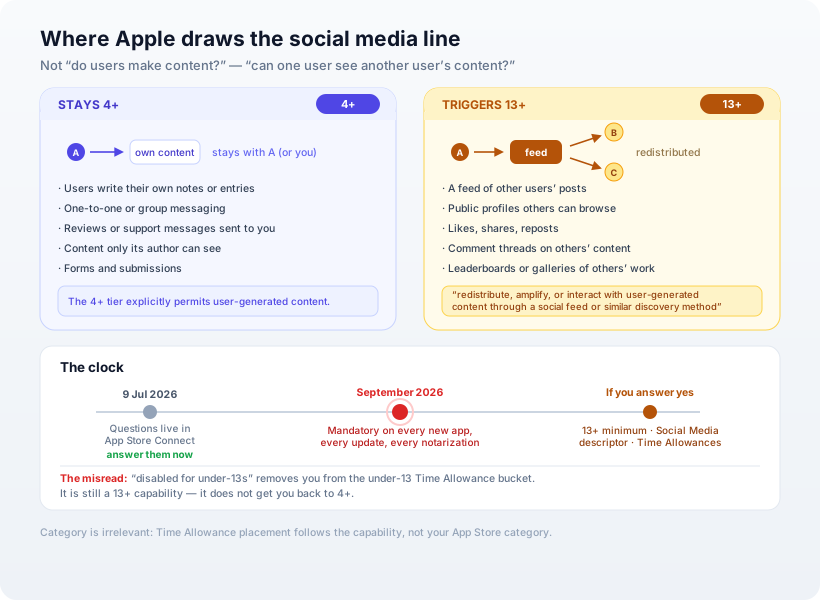
the ability to redistribute, amplify, or interact with user-generated content through a social feed or similar discovery method
Two consequences follow. Your product page gains a Social Media content descriptor, and the app is placed in the Time Allowance category for Social Media in iOS 27, iPadOS 27, and macOS 27 — regardless of which App Store category you selected. Being filed under Productivity or Education doesn't exempt you.
And per Apple's age rating values reference, social media sits in the 13+ tier. Declaring it means your app cannot be rated lower.
The line is redistribution, not user-generated content
This is where teams will get it wrong, because "user-generated content" and "social media" get used interchangeably and Apple treats them as different things.
The 4+ tier explicitly permits user-generated content and messaging. So a journalling app where users write entries, a support chat, a notes app, a form that collects submissions — none of that is social media capability on its own. The user makes content; the content stays with them or goes to you.
The 13+ trigger is what happens next. If your app takes one user's content and surfaces it to another user — a feed, a public profile, a comment thread, a shared gallery, likes and reposts, a leaderboard of other people's submissions — you've crossed from creation into redistribution and discovery.
| Stays 4+ | Triggers 13+ |
|---|---|
| Users write their own notes or entries | A feed of other users' posts |
| One-to-one or group messaging | Public profiles others can browse |
| Reviews or support messages sent to you | Likes, shares, reposts |
| Content only its author can see | Comment threads on others' content |
| Forms and submissions | Leaderboards or galleries of others' submissions |
The awkward middle is real. A recipe app where users publish recipes others can browse is social media. A fitness app with a friends leaderboard is arguably social media. If your product has a "community" tab you added in a quiet sprint two years ago, it probably qualifies now.
The declaration isn't asking whether you built a social network. It's asking whether one user can see another user's content — and a surprising number of ordinary apps can.
The exception everyone will misread
Apple offers a carve-out: if you indicate that social media capabilities are disabled for anyone under 13, the app isn't included in the Time Allowance category for Social Media for under-13 users.
Read what that does and doesn't do. It changes Time Allowance treatment. It does not change your age rating — "social media disabled for users under 13" is itself listed as a 13+ capability. Both answers land you at 13+.
So the toggle is worth setting if you genuinely gate the feature by age, because it keeps your app out of a screen-time bucket parents will be managing. It will not get you back to a 4+ rating, and any plan that assumes it will is going to produce an unpleasant surprise in September.
What to do before September
- Audit every surface where one user sees another's content. Feeds, profiles, comments, shared collections, leaderboards, "popular this week," anything with a
publicflag. Write the list down — most teams have never enumerated it. - Answer the questions now, not at submission. They're live in App Store Connect today. Discovering a rating change while shipping a hotfix is the worst possible time.
- Model what 13+ costs you. If your app is aimed at families or young learners, moving from 4+ to 13+ affects discovery, parental approval, and school procurement. That may change what you're willing to ship.
- Decide whether the feature earns its rating. This is the real question. A community tab with modest engagement that pushes an education app to 13+ is a bad trade. Removing it is a legitimate option, and now is the moment to consider it.
- If you keep it, consider gating under-13 access properly — it doesn't recover 4+, but it does keep you out of the under-13 Social Media Time Allowance bucket.
- Tell whoever owns your store listing. The Social Media descriptor appears publicly on your product page. Marketing should not learn about it from a screenshot.
Our opinion
This is Apple pricing an externality, and on balance we think that's right. Feeds are the mechanism that turns a tool into something you check compulsively, and Time Allowances exist because parents asked for control over exactly that. Making the capability declarable — and visible on the product page — puts the cost of a feed where it belongs: on the app that shipped it.
The part we'd push back on is the definition's breadth. "Similar discovery method" is doing a lot of work, and it will catch products nobody would call social: a plant-identification app with a community gallery, a running app with a friends list. Those apps now carry the same descriptor as an infinite scroll designed to be addictive, and the App Store gives users no way to tell them apart.
The useful reframe for teams: treat September as a forcing function to ask whether your social feature is actually load-bearing. Many were added because feeds were the default growth tactic of the last decade, not because the product needed one. If a feature can't survive the question "is this worth a 13+ rating?", that's information about the feature, not about the policy.
How Ashvara helps
We ship a lot of App Store submissions, and the pattern we see is that platform rules cost far more when they're discovered at review than when they're planned for. Auditing which surfaces redistribute user content is a short piece of work; finding out at submission that your family app is now 13+ is not.
That's part of our iOS app development practice, and it's the same discipline behind shipping without drama. If you're not certain whether your app trips the definition, tell us what it does and we'll walk the surfaces with you before September.
Sources: Apple Developer, "Age rating questionnaire now includes social media questions," 9 July 2026 (developer.apple.com); Apple, "Age rating values and definitions" — social media as a 13+ capability (developer.apple.com).