Swift 6 concurrency: the data-race reckoning is here
Building on the iOS 26 SDK is now mandatory - but only 38% of teams have turned on Swift 6's data-race safety. That gap is where the crashes hide.
5 min read
Swift 6's headline feature is that it moves an entire class of bug - the data race - from a rare, unreproducible runtime crash to a compile-time error you fix before you ship. As of 2026 this stopped being optional to think about: every new App Store build must compile against the iOS 26 SDK. But there's a catch most teams have missed, and it's the whole point of this post. Building on the new SDK is not the same as turning on data-race safety. The first is now mandatory; the second is a choice - and the gap between them is exactly where concurrency bugs keep living.
Why this matters now
The numbers tell a story of a half-finished migration. Since April 28, 2026, all new App Store submissions must build with Xcode 26 and the iOS 26 SDK, and in a June 2026 developer survey 94% of developers were already doing so. Yet only 38% had actually adopted the Swift 6 language mode (index.dev). iOS 26 itself now runs on 79% of active iPhones, so the platform is ready - the codebases are the lagging part.
That 94%-vs-38% gap is the real headline. Most teams cleared the bar Apple forced (new SDK) and stopped short of the bar that actually eliminates the bugs (Swift 6 mode). They're shipping on modern tooling with the safety net switched off.
What Swift 6 actually changes
Data-race safety isn't a linter or a runtime sanitizer - it's the type system. The compiler now understands concurrency and refuses to build code that could race (The Swift Programming Language - Data Race Safety). Three mechanisms do the work:
- Actor isolation - the compiler tracks which code runs on which actor (or the main thread), and stops you from touching an actor's mutable state from the wrong context.
Sendableconformance - only types proven safe to move between threads are allowed to cross an isolation boundary.- Non-
Sendablevalues can't leak - pass something thread-unsafe across a concurrency boundary and it's a compile error, not a Tuesday-afternoon production crash.
Swift 6 turns "this might race under load" from a bug you discover from a crash report into a bug the compiler won't let you commit. The failures move left, to the one place they're cheap to fix.
The payoff is specific: data races are the worst bugs to chase because they're timing-dependent, rarely reproduce on your machine, and often surface only under real user load. Catching them at compile time removes an entire category of "we can't reproduce it" tickets.
How to actually migrate: incrementally
The mistake is flipping the whole project to Swift 6 mode in one commit and drowning in errors. Swift is explicitly designed for incremental, module-by-module migration, and the sane path has three stages:
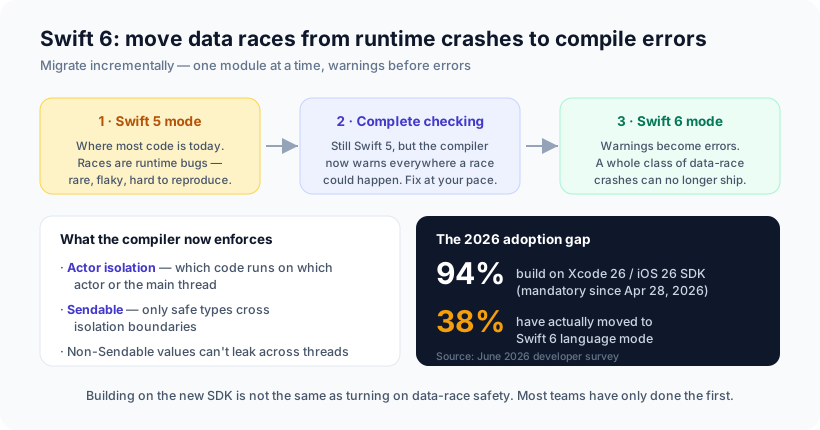
- Stay in Swift 5 mode - where most code is today.
- Turn on complete concurrency checking - still Swift 5, so nothing breaks the build, but the compiler now emits warnings everywhere a data race is possible. This is your to-do list, generated for free.
- Enable Swift 6 mode - once the warnings are handled, flip the switch and those warnings become enforced errors. From then on, the whole class of bug can't ship.
Do it one module at a time, starting with the ones that own your concurrency (networking, caches, shared stores). Apple's guide to adopting strict concurrency walks the same staged path. The reason this beats a big-bang migration is that each module you finish is permanently protected, and you never face more than one module's worth of errors at once.
Our opinion
Our take: building on the iOS 26 SDK without adopting Swift 6 mode is leaving the most valuable feature in the box. The mandatory part (new SDK) gets you Apple's compliance checkbox and the Liquid Glass look; the optional part (data-race safety) is what actually makes your app more reliable. Teams that stop at 94% got the paperwork and skipped the payoff.
We'd also push back on treating the migration as a big scary project to defer. The staged approach means you can start today by enabling complete concurrency checking and reading the warnings - that alone is a free audit of every place your app risks a race, with zero commitment to fixing them yet. The apps we ship treat concurrency safety as table stakes, because on mobile a race that only shows up under load is a one-star review you can't reproduce.
How Ashvara helps
We build iOS apps in modern Swift, and strict-concurrency migration is exactly the kind of unglamorous reliability work we do well - staging the move module by module, resolving actor-isolation and Sendable warnings without contorting your architecture, and getting you to enforced Swift 6 mode instead of stalling at "builds on the new SDK." It's the same care we bring to shipping updates that pass review the first time.
If you have an app that needs to be reliable under real load - or a Swift 6 migration that's stalled halfway - that's our iOS development work. Tell us about it and we'll get the safety net switched on.
Sources: The Swift Programming Language - Data Race Safety and Apple - Adopting strict concurrency in Swift 6.