Repository intelligence: your codebase is the context now
AI coding moved from autocompleting lines to understanding whole repos - and running several agents on one task. Here's what changes for how teams build.
5 min read
The story of AI coding in 2026 isn't a smarter autocomplete - it's that the tools now understand your whole repository, and you can run several agents on the same task and compare how they solve it. The unit of work moved from "finish this line" to "make this change across the codebase, understanding how the files relate and why they got that way." The role that follows moved with it: less typing, more directing - framing the task, choosing between approaches, and judging the result. This is a real shift in how software gets built, and it rewards teams who get good at orchestration rather than teams who just adopt a faster autocomplete.
Why this matters now
Two concrete developments mark the change. First, GitHub's Agent HQ (announced February 2026) lets you run coding agents from multiple providers - Copilot, Claude, and Codex - directly inside GitHub and your editor, with context, history, and review staying attached to the repo (GitHub). You can hand the same task to more than one agent and watch each reason about the trade-offs differently, then pick the best result.
Second, the adoption curve is steep enough to reset defaults. Gartner projects 40% of enterprise applications will embed task-specific AI agents by the end of 2026, up from under 5% in 2025, with a reported net average productivity gain around 19.3% where they're used. Both Gartner and Forrester frame 2026 as the breakthrough year for multi-agent systems - specialized agents working under coordination rather than one model doing everything.
The mechanism: from lines to relationships
"Repository intelligence" is the phrase for what actually changed, and it's worth being precise about.
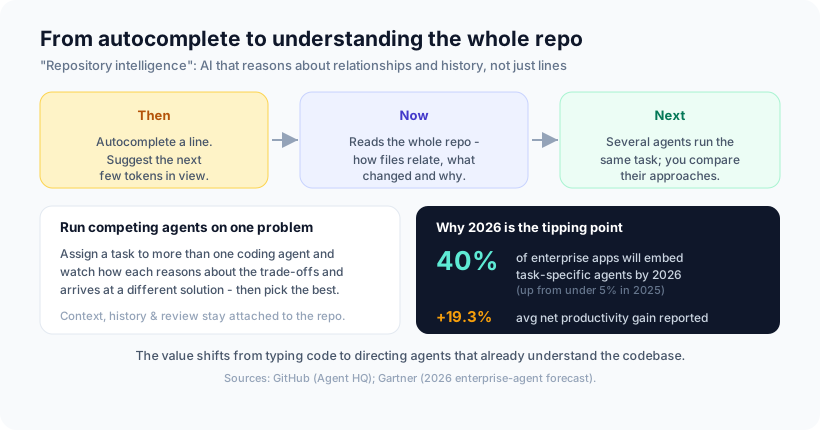
Old assistants worked at the level of the cursor: predict the next few tokens from what's on screen. Repository-intelligent tools work at the level of the codebase: they read across files, follow how modules depend on each other, and use history to understand what changed and why. That's what lets an agent take "add rate limiting to the public API" and actually thread it through the right middleware, config, and tests - rather than autocompleting a plausible-looking line in one file.
Running agents in parallel builds on that. Because each agent already understands the repo, you can assign one task to several and treat their different solutions as options to evaluate - a small tournament instead of a single guess.
The scarce skill stopped being "write the code" and became "frame the task precisely and judge the result." When three agents hand you three working solutions, the value is in knowing which one is right.
What this changes for teams
The practical implications are less about tools and more about how work is organized:
- The bottleneck moves to specification and review. If an agent can implement a well-framed task across the repo, the leverage is in framing it well and reviewing it rigorously - not typing it. Vague requirements now produce confidently wrong changes faster.
- Review discipline becomes non-negotiable. More generated code, more often, means the hidden cost of unreviewed AI code compounds unless a human stays accountable for every merge.
- Parallel agents suit some tasks, not all. Running competing agents shines when a task has genuinely different valid approaches; it's wasted motion on a mechanical change. Knowing when multiple agents help and when they don't is part of the new skill set.
Our opinion
Our view: repository intelligence is a real productivity unlock, and it moves the hard part of engineering rather than removing it. The teams that win here treat agents as fast implementers to be directed and checked, and invest in the two things that now decide outcomes - precise task framing and serious review. The teams that treat "the agent understands the repo" as license to review less will ship the debt faster than they ship the features.
We'd also temper the multi-agent excitement with a cost note: running three agents on every task is three times the tokens, and most tasks don't have three meaningfully different right answers. Reserve the tournament for the decisions that are genuinely open, and let a single well-directed agent handle the rest. That discipline - matching the method to the task - is the same one behind right-sizing the model to the job.
How Ashvara helps
We build software with these tools every day, with the discipline that makes them pay off: precise specs, real code review on every change, and agents directed at the tasks they're genuinely good at rather than pointed at everything. The result is the speed of repository-intelligent AI without the pile of plausible-but-wrong code that comes from skipping the judgment.
If you want to put AI coding to work in your team - or build a product on top of these capabilities - that's our AI solutions work. Talk to us and we'll help you get the productivity without inheriting the debt.
Sources: GitHub - Agent HQ: use Claude and Codex on the same task; Gartner - task-specific AI agents in 40% of enterprise apps by 2026.