The delegation gap: why AI does most of the work but runs little of it
Developers use AI in ~60% of their work but can fully delegate only 0-20% of tasks. That gap - not the hype - is what actually shapes AI-era engineering.
5 min read
The most useful number in AI-assisted development this year isn't how much faster agents are - it's the distance between two facts: developers now use AI in roughly 60% of their work, but report being able to fully delegate only 0-20% of tasks. That distance has a name - the delegation gap - and it's a more honest description of where things actually stand than either the "AI writes everything now" hype or the "it's all overblown" backlash. AI is genuinely woven through most of the work; it's genuinely in charge of very little of it. Understanding why that gap exists is what separates teams getting durable value from teams chasing a fantasy of full automation.
Why this matters now
These figures come from Anthropic's 2026 Agentic Coding Trends Report, and they reframe the whole conversation. ~60% of developer work now involves AI. Only 0-20% can be fully delegated. The report calls the era this defines the orchestration era: the bottleneck has moved from writing code to directing the systems that write it.
Two more numbers fill in the picture. About 27% of AI-assisted work is net-new - tasks that simply wouldn't have been done otherwise, which means AI is expanding the scope of what teams attempt, not only speeding up what they already did. And at the capability frontier, a single autonomous run refactored a 12.5-million-line library over seven hours at 99.9% numerical accuracy (a widely-cited Rakuten result in the report). So the ceiling is genuinely high - and yet day-to-day delegation stays low. That tension is the story.
Why the gap exists
The gap isn't a temporary artifact of immature tools that a better model will close next quarter. It's structural, and it comes down to the parts of engineering that aren't typing.
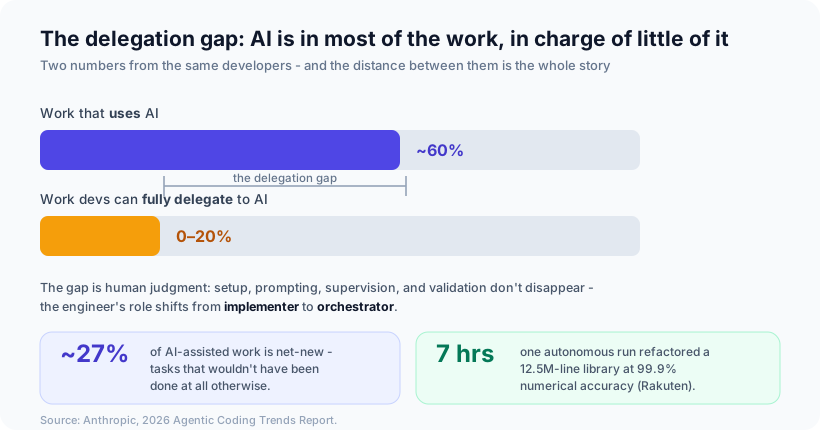
Effective AI collaboration still requires active human participation: setup, prompting, supervision, validation, and judgment - especially for high-stakes or context-dependent work. An agent can generate a change in seconds, but someone has to frame the problem correctly, feed it the right context, notice when the output is confidently wrong, and own the decision to ship. Those steps don't vanish as models improve; if anything, they become the job.
That's why the report's headline is a role change: the engineer shifts from implementer to orchestrator. The value of the work moves toward system design, problem decomposition, agent coordination, and quality evaluation - the things that decide whether delegated work is any good.
The productivity gain isn't from removing the human from the loop. It's from making the human's part of the loop - the framing, the checking, the judgment - faster and sharper. Teams that try to delete that step don't get more automation; they get more rework.
What this means in practice
If the gap is structural, the winning move is to invest in the human side of the loop rather than wait for it to disappear:
- Get better at framing, not just prompting. The scarce skill is decomposing a fuzzy goal into tasks an agent can actually execute and you can actually verify - what we've called context engineering.
- Build the verification in. If you can't cheaply check an agent's output, you can't safely delegate it. Tests, types, and review are what turn "the agent did something" into "the agent did the right thing."
- Delegate by task shape, not by ambition. Some work genuinely parallelizes across agents; some is a dependent chain a single agent handles better. Knowing when multiple agents help and when they don't is part of orchestration.
- Expect scope to grow. With ~27% of AI work being net-new, the honest promise isn't "same work, fewer people" - it's "more ambitious work, same people." Plan for the former and you'll misread the whole shift.
Our opinion
Our view: the delegation gap is the feature, not the bug. The teams that will get the most from AI are the ones that accept the human stays in the loop for judgment and get excellent at that part - not the ones betting on a near-future where you hand over the keys and walk away. That bet keeps losing quietly, in the form of confidently-wrong output that ships because nobody was orchestrating.
We'd also push back on reading "0-20% fully delegable" as disappointing. It sits right next to "60% of work uses AI" and "27% is net-new" - which together describe a genuinely large change in how much gets done. The gap isn't a ceiling on value; it's a description of where the value comes from. It comes from better orchestration, which is a skill, not a wait. This is the same thread as the hidden cost of unreviewed AI code: the speed is real, and it's only real if you keep the judgment in.
How Ashvara helps
We build AI features and agentic workflows for real products, and we do it from the orchestration-era premise rather than the automation fantasy: frame the tasks so an agent can execute them, wire in the verification so delegated work is trustworthy, and keep a human accountable for what ships. That's how you get the speed without inheriting a pile of plausible-but-wrong output.
If you're trying to put AI to work in your product and want it architected around where the value actually is, that's our AI solutions work. Talk to us and we'll help you close the gap on the human side, where it closes.
Source: Anthropic - 2026 Agentic Coding Trends Report (~60% of work uses AI, 0-20% fully delegable, ~27% net-new work, the implementer-to-orchestrator shift).