One agent isn't enough: when to use multiple AI agents
Multi-agent systems beat a single model by ~90% on the right tasks - and burn 15x the tokens on the wrong ones. Here's how to tell which is which.
5 min read
The most capable AI systems shipping in 2026 aren't one big model doing everything - they're a lead agent that splits a task and runs several specialist agents in parallel. On the right kind of work this is a large, measurable win; on the wrong kind it's a way to spend fifteen times the tokens for a worse answer. The whole skill is knowing which is which. This post is the decision, not the hype: what the orchestrator-worker pattern actually is, the evidence that it works, and the concrete test for whether your problem is one that a team of agents helps or one where a single agent still wins.
Why this matters now
Agents stopped being demos and became infrastructure this year. As of July 2026, 78% of enterprise AI teams have agents backed by the Model Context Protocol in production, and MCP's SDKs crossed roughly 97 million installs in about 16 months - a curve steeper than React's early adoption. Once agents can reliably call tools, the next question is architectural: do you scale by making one agent smarter, or by coordinating several?
The data points hard at "several," but only for a specific shape of problem. In Anthropic's published research system, an orchestrator using a stronger model with several weaker subagents outperformed a single top-tier model by 90.2% on a research evaluation (Anthropic Engineering). The same writeup is candid about the cost: multi-agent systems burn about 15x the tokens of a normal chat. That ratio is the entire economic argument in one number.
The pattern: orchestrator and workers
The dominant design is the orchestrator-worker pattern, and it's worth understanding as a mechanism, not a buzzword.
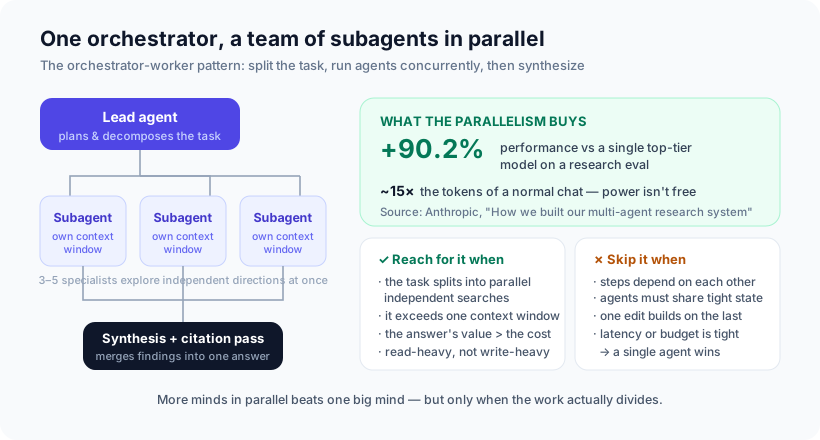
A lead agent reads the request, breaks it into subtasks, and describes each one to a subagent - giving it an objective, an output format, the tools to use, and clear boundaries. The subagents run in parallel, each in its own context window, and hand their findings back. A final synthesis pass (often with a separate citation step) merges everything into one answer. Anthropic's system spins up 3-5 subagents per query this way.
The reason this beats one giant model is not magic - it's context. A single agent has one context window, and hard research questions overflow it: it has to hold the plan, every source, and every intermediate thought in the same limited space. Splitting the work gives each subagent a fresh, focused window on its slice, so the system as a whole can reason over far more material than any single window holds. Parallelism also cuts wall-clock time when the subtasks are genuinely independent.
The test: does your task actually divide?
Here's the part most "build an agent swarm" advice skips. Multi-agent only helps when the work decomposes into independent parallel pieces. Use this as the dividing line:
- Multi-agent fits when the task is breadth-first: "research these eight vendors," "check this claim against many sources," "explore several independent directions and compare." Each subagent can go off alone and the results merge cleanly. It also fits when one context window simply can't hold the material.
- A single agent wins when the work is a dependent chain: each step needs the output of the last, agents would have to share tight, constantly-changing state, or one edit builds directly on the previous one. Coding a feature is usually this - which is why coding tends to stay single-agent even at the frontier.
If your subtasks need to talk to each other constantly to stay consistent, you don't have a parallel problem - you have one problem you've split into pieces that now have to be glued back together. Keep it in one agent.
The failure mode is treating multi-agent as a default. Point five agents at a task that's really a single dependent chain and you get 15x the cost, more coordination bugs, and answers that don't line up - because you parallelized something that was never parallel. Anthropic's own guidance is blunt that these systems suit tasks where the value of the outcome justifies the token cost, not everyday work.
Our opinion
Our view: multi-agent is a genuine capability unlock for the narrow band of problems that are read-heavy, breadth-first, and expensive to get wrong - deep research, large-scale analysis, wide information-gathering. For most product features, a single well-instructed agent with good tools and solid context engineering is faster, cheaper, and easier to debug, and you should exhaust that before reaching for a fleet.
We'd also argue the token math should be a first-class design input, not an afterthought. A 15x multiplier turns "let's add more agents" into a real budget decision. The teams getting value here decide deliberately which few tasks earn the multi-agent treatment and keep everything else lean - the same discipline behind why most companies don't need the biggest model for most jobs. More agents is a tool, not a scoreboard.
How Ashvara helps
We build agentic features for real products, which means we start with the boring question the hype skips: does this task actually divide? We'll design a single-agent system when that's the right call, a coordinated multi-agent one when the work genuinely parallelizes, and we'll wire it to your data cleanly over MCP either way - with the token cost sized up front so you're not surprised by the bill.
If you're weighing an AI feature and want it architected on evidence rather than trend-following, that's our AI solutions work. Talk to us and we'll help you pick the design that fits the problem.
Source: Anthropic - How we built our multi-agent research system (orchestrator-worker architecture, +90.2% result, ~15x token cost, and when not to use it).