Context engineering: the real skill behind AI agents that work
The teams whose AI features work aren't using better models - they're feeding them better context. Why context quality, not size, is the 2026 bottleneck.
4 min read
The teams whose AI features actually work in production aren't using a smarter model than everyone else - they're feeding the model better context. In 2026 the limiting factor for AI agents stopped being the model's raw capability and became "context engineering": the discipline of assembling exactly the right information for each step, rather than stuffing everything into the prompt and hoping. It's the least glamorous part of building with AI and, increasingly, the part that decides whether a feature ships or embarrasses you.
Why this matters now
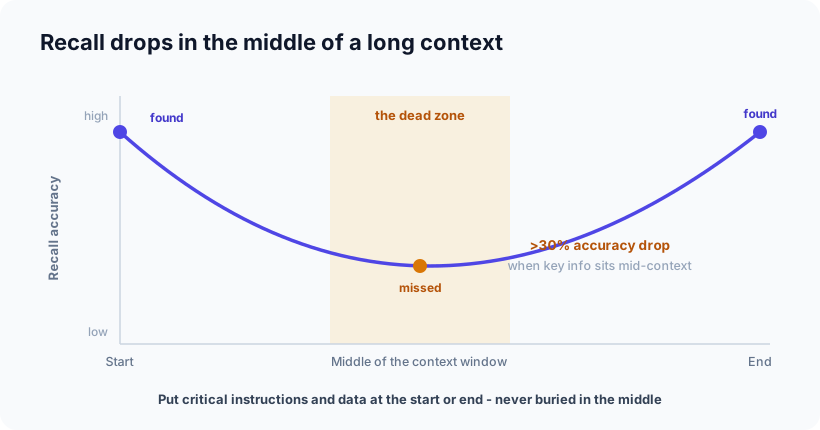
Two findings reframed how serious teams build. First, more context is not better context. The "lost in the middle" effect - first documented by Stanford and UC Berkeley researchers in 2023 and confirmed repeatedly since - shows that a model's recall forms a U-shape: it attends well to the start and end of its context and poorly to the middle, with accuracy dropping more than 30% when the relevant fact sits mid-window (overview).
Second, this is where real systems fail. By one analysis, roughly 65% of enterprise AI failures in 2025 were attributed to context drift or memory loss during multi-step reasoning (Mem0) - not to the model being incapable, but to it being handed the wrong or too much information at the wrong moment. And the tooling gap is telling: industry surveys show 89% of teams have agent observability but only ~52% run evals (LangChain State of Agent Engineering) - most teams can see their agent behaving badly but haven't built the harness to systematically improve what goes into it.
What "context engineering" actually means
It's the set of techniques that govern what enters the model's window on any given call. The core moves:
- Retrieve, don't dump. Pull only the passages relevant to this step (RAG), instead of pasting a whole knowledge base. Less noise means higher accuracy and lower cost.
- Position deliberately. Put the most important instructions and data at the very start or end of the prompt - never buried in the middle where recall collapses.
- Summarize and compact. In multi-turn agents, distill earlier turns into a running summary so the window doesn't fill with raw history and push the important parts into the dead zone.
- Deduplicate and filter. Strip near-duplicate and semantically-similar-but-irrelevant content, which actively distracts the model ("distractor interference").
- Scope memory. Give the agent the specific facts this task needs, not everything it has ever seen.
Context is not a bucket you fill - it's a payload you design. The best-performing agents send the model the least information that still fully answers the question.
The mechanism: why less wins
A model's attention is finite and it dilutes as the token count grows. Every irrelevant paragraph you include does three bad things at once: it pushes the useful content toward the low-recall middle, it dilutes attention across more tokens, and it adds plausible-looking distractors the model can latch onto. This is why the naive instinct - "the model has a huge context window, so give it everything" - backfires. When the context entering the window is governed, fresh, and scoped to the task, the degradation curve flattens and the same model suddenly looks far more capable.
This connects directly to two things we've written about: it's the reason RAG isn't dead even with long-context models, and it's the practical half of how AI agents remember. Context engineering is the umbrella over both.
Our opinion
We think "context engineering" is a better name for most of what people call "AI work" than "prompt engineering" ever was. Prompts are the wording; context is the payload - and the payload is where reliability is won or lost. Our strong view: if your AI feature is unreliable, the first suspect is your context pipeline, not the model. Swapping in a bigger model is the expensive, tempting move that usually disappoints, because it doesn't fix a retrieval step that's feeding the model noise.
The corollary is that you can't improve what you don't measure. That 89%-vs-52% gap is the real story of 2026 - plenty of teams are watching their agents, far fewer are running evals that tell them whether a change to the context pipeline made things better or worse. Build the eval harness early. It's unglamorous and it's the difference between guessing and engineering.
How Ashvara helps
Building a reliable AI feature is mostly plumbing: the retrieval step, the summarization, the scoping, and the evals that prove it works - not the demo prompt. That's exactly the work we do. We design the context pipeline, instrument it so you can see and measure agent behaviour, and tune what enters the window until the feature is dependable rather than merely impressive in a screen recording.
If you've got an AI feature that dazzles in a demo but wobbles with real users, that's almost always a context problem, and it's fixable. See our AI solutions work, then tell us what's misbehaving - we'll start with the pipeline.
Sources: LangChain - State of Agent Engineering; Mem0 - Context Engineering for AI Agents; "Lost in the Middle" overview; Datadog - State of AI Engineering.