The hidden bill of AI-generated code
AI assistants ship code fast - and technical debt and leaked secrets behind it. Winning teams treat the assistant as an untrusted contributor, not a colleague.
5 min read
AI coding assistants made it easy to produce a lot of code fast in 2026 - and the data now shows a maintainability gap and a security bill opening up behind it. This isn't an argument against AI-assisted development; we use it every day and it's genuinely made teams faster. It's an argument about how. The velocity is real, but so is the debt: more duplication, less reuse, fewer refactors, and a sharp rise in leaked secrets and vulnerabilities. The teams getting durable value are the ones who treat the assistant as a fast but untrusted contributor - fenced by review, provenance, and scanning - not as a trusted colleague whose output ships unread.
Why this matters now
The measurements are in, and they point the same way. GitClear's analysis of real repositories found copy-pasted code climbed from 9.4% of changed lines in 2022 to 15.7% in the first half of 2026, while the markers of healthy code went the other way: cross-file reuse down ~35%, refactoring down ~70% (GitClear). More code, written faster, but less of it reused or cleaned up.
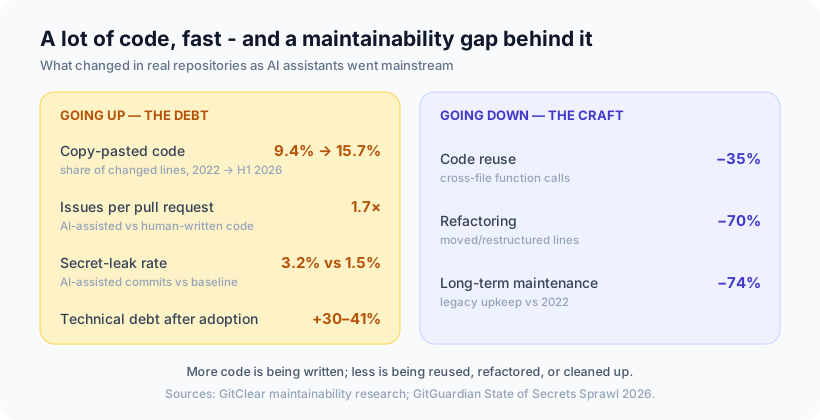
Quality and security track it. Pull requests containing AI-assisted code carry 1.7x more issues than human-written code, and organizations report technical debt rising 30-41% within six months of broad AI-tool adoption. On the security side, GitGuardian's State of Secrets Sprawl 2026 found 28.65 million new hardcoded secrets hit public GitHub in 2025 (a 34% jump), and AI-assisted commits leak secrets at 3.2% versus a 1.5% baseline (GitGuardian). Georgia Tech's security researchers traced 35 CVEs in a single month directly to AI coding tools, estimating the true count is 5-10x higher.
The mechanism: speed without the slow parts
Here's why this happens, and it's not mysterious. Good engineering is mostly the slow parts - noticing that this logic already exists and calling it, restructuring when a module gets unwieldy, deleting dead code, checking that a snippet didn't hardcode a key. An assistant optimizes for producing a working answer to the prompt in front of it. It will happily regenerate a near-duplicate of code that already exists three files over, because it isn't looking three files over.
So the natural output of unsupervised AI coding is more code that works but doesn't fit: duplicated instead of reused, added instead of refactored, plausible instead of verified. Each individual PR looks fine. The debt is only visible in aggregate, months later, when the codebase is twice the size it needed to be and nobody remembers which copy is the real one.
AI didn't remove the hard part of engineering - it removed the friction that used to force you to do the hard part. The friction was doing work.
What actually works
The fix isn't "stop using AI." It's putting the guardrails back that the speed removed:
- Review AI code like you'd review an outside contributor's - because that's what it is. The Cloud Security Alliance's guidance is blunt: AI belongs in the pipeline "only if it is fenced by provenance, scanning, review, rollback, and governance that assumes the assistant is not a trusted colleague."
- Scan every commit for secrets and vulnerabilities automatically - the leak rate is 2x higher, so a secret scanner in CI is no longer optional.
- Budget for refactoring explicitly. If reuse and refactoring are the metrics collapsing, make them first-class work, not something you'll get to later.
- Keep a human accountable for each merge. Senior engineers already report spending 20-35% more time reviewing when juniors lean hard on assistants - plan for that, don't pretend it away.
Our opinion
We're firmly pro-AI-assisted development - it's part of how we ship. But our strong view is that the productivity is only real if you keep the review discipline, and the teams treating "the AI wrote it" as a reason to review less are the ones quietly accumulating the debt in that chart. Faster typing was never the bottleneck in software; understanding, structure, and correctness were - and those are exactly the parts an assistant doesn't do for you.
This connects to something we've written before: AI changed how we build, not whether craft matters, and reliability comes from engineering the system around the model, not from trusting its raw output. Use the assistant to go faster on the parts that are genuinely mechanical. Keep a human firmly in the loop on the parts that decide whether the code lasts.
How Ashvara helps
We build with AI assistance and the review discipline that keeps it from turning into debt - secret scanning in CI, real code review on every change, refactoring treated as work rather than an afterthought, and a human accountable for what merges. You get the speed without inheriting a codebase that's twice the size it should be and leaking keys.
If you're worried your AI-accelerated codebase is accumulating debt you can't see - or you're setting up the guardrails before it does - that's the kind of engineering and AI work we do. Talk to us and we'll help you keep the velocity without the bill.
Sources: GitClear - The AI Code Quality Maintainability Gap (2026); GitGuardian - State of Secrets Sprawl 2026; Cloud Security Alliance - AI-generated code vulnerability surge.