You don't need a frontier model: the case for small language models
Most teams pay frontier prices for work a small model does just as well. The 2026 move is right-sizing - SLM-first, escalate only the hard part.
5 min read
The biggest AI cost mistake we see in 2026 is sending every request to a frontier model when a small one would do the job just as well. The real shift this year isn't a bigger model - it's right-sizing. Small language models (roughly 3-10 billion parameters) now handle a large share of real application work at a fraction of the cost, and the best-designed systems route accordingly: keep the routine work on a small model, and escalate to a frontier model only for the genuinely hard part. Done well, this cuts cost by roughly 10x with little or no drop in quality.
Why this matters now
This stopped being a fringe opinion and became a research position. NVIDIA's 2025 paper, Small Language Models are the Future of Agentic AI, argues directly that SLMs are "sufficiently powerful, inherently more suitable, and necessarily more economical for many invocations in agentic systems." The economics are stark: a 7B model costs 10-30x less to serve than a 70-175B model, and can be fine-tuned in hours rather than weeks.
The quality gap is smaller than the price gap suggests. SLMs now deliver 80-90% of GPT-4-class quality on focused tasks, and specific small models punch far above their size - Microsoft's Phi-4 (14B) posts 84.8% on MMLU, beating a frontier model on math while fitting on a 12GB GPU (2026 SLM roundup). Gartner projects organizations will use task-specific SLMs 3x more than general LLMs by 2027. This isn't "cheaper but worse." For the right tasks, it's cheaper and good enough.
The mechanism: SLM-first routing
The design that unlocks the savings is simple to describe: a router sends each request to the smallest model that can handle it, and only escalates when needed.
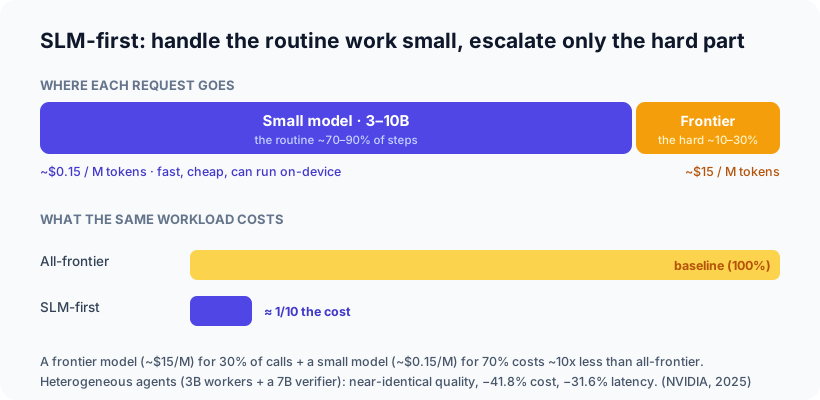
The math is worth internalizing. Put a frontier model at ~$15 per million tokens on the 30% of calls that truly need it, and a small model at ~$0.15 per million on the other 70%, and the total costs about 10x less than routing everything to the frontier (NVIDIA). And this is measured, not theoretical: one study of a heterogeneous agent system - small 3B models doing the lower-level work, a 7B model kept on as the verifier - held quality nearly identical to an all-7B baseline while cutting API cost 41.8% and latency 31.6%.
Where small models win (and where they don't)
Right-sizing means matching the model to the task honestly. From the evidence, small models are strong at exactly the work most applications are made of:
- Structured extraction - pulling fields out of text or documents
- Classification and routing - tagging, triage, deciding which tool or path a request takes
- Summarization of bounded content
- Tool-calling - the "which function, what arguments" decisions inside an agent
- Well-scoped, repeated tasks - the same job, millions of times, where cost and latency compound
They're the wrong choice for open-ended reasoning over long context, broad world knowledge, or novel problems with no clear structure. That's what the frontier model is for - which is exactly why you want to save it for those cases instead of burning it on a classification call.
The question in 2026 isn't "which is the best model?" It's "what's the smallest model that reliably does this task?" Those are very different questions, and only the second one controls your bill.
Our opinion
We think "just use the biggest model" is the new premature optimization - the expensive default that feels safe and quietly wastes money. Our strong view: start with the smallest model that passes your evals, and escalate deliberately. It's the same instinct behind our advice to start with Postgres before adding a vector database and to engineer context rather than dump it - don't buy capability the task doesn't need.
There's a second, quieter payoff that matters as much as cost: small models can run on-device, which means private and offline by default. A task that runs on a 3B model on the user's phone never sends their data to anyone's server - the thesis behind on-device AI. Right-sizing isn't only a finance decision; it's often a privacy and reliability decision too.
The one honest caveat: this only works if you can tell whether the small model is good enough, which means you need evals. Guessing doesn't scale. Measure the small model against the task, set the escalation threshold on evidence, and you get the savings without the risk.
How Ashvara helps
Building a cost-efficient AI feature is mostly about the routing and the evals, not the model name. We design the SLM-first architecture - which tasks stay small, where the escalation threshold sits, and the eval harness that proves the small model holds up - so you ship something fast, private, and an order of magnitude cheaper to run than the default.
If your AI feature works but the bill is climbing, the fix is usually right-sizing, not a bigger model. That's the kind of AI solutions work we do - tell us what you're running and we'll find where a smaller model does the same job.
Sources: NVIDIA Research - Small Language Models are the Future of Agentic AI (arXiv 2506.02153) and NVIDIA Technical Blog; Best Small Language Models 2026 (Intuz); Small Language Models for On-Device Agents 2026.