Your API needs an MCP server (and it's a security boundary)
AI agents are a new class of API consumer, and MCP is how they call your backend. The interesting work isn't the tools - it's auth, scoping, and audit.
5 min read
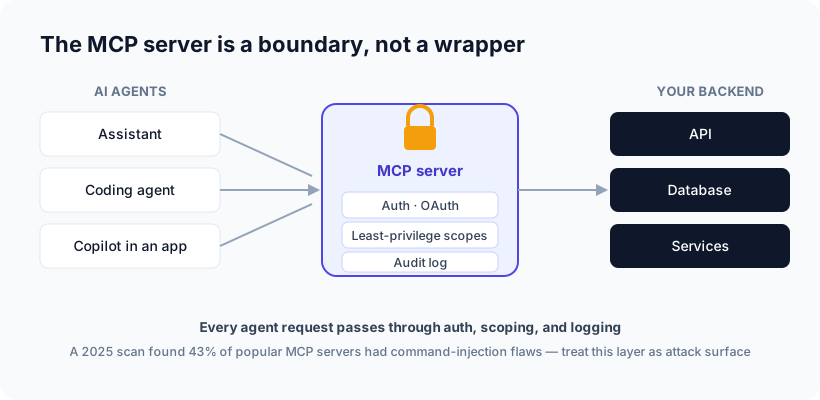
In 2026, AI agents became a real class of API consumer - and the Model Context Protocol (MCP) is how they discover and call your backend. If your product has an API, exposing an MCP server is quickly becoming table stakes: it's what lets an assistant, a coding agent, or an in-app copilot actually do things in your system rather than just talk about them. But here's the part most guides skip: an MCP server is a new authenticated boundary into your backend, not a thin wrapper around it. Get the auth, scoping, and audit right and it's powerful. Get them wrong and you've handed a language model a key to your database.
Why this matters now
MCP went from a proposal to infrastructure fast. Anthropic introduced it in late 2024; by 2026 it's a vendor-neutral standard that every major AI client speaks - assistants, coding tools, and copilots alike. The ecosystem numbers tell the story: the official registry passed 10,000+ active public servers, with 97M+ monthly SDK downloads across Python and TypeScript, and roughly 28% of Fortune 500 companies running MCP servers in production, per 2026 adoption data.
The protocol is maturing to match. The 2026-07-28 specification adds a stateless core (so remote servers scale behind an ordinary load balancer), long-running Tasks, and - crucially - a standardized enterprise auth layer with OAuth, role-based access control, and audit logging. That last addition is a tell: the ecosystem learned, the hard way, that this is a security surface.
The mechanism: how an agent uses your backend
An MCP server advertises a set of tools - named operations with typed inputs, each mapping to something your backend can do ("search orders", "create ticket", "refund"). The agent reads those definitions, decides which to call and with what arguments, and your server executes the call against your real API or database. The agent never touches your internals directly; everything passes through the server you control.
That "server you control" is the whole game. It's the one place to enforce who's calling, what they're allowed to touch, and what happened.
Treat it as attack surface, because it is
Here's the sobering data. When security firm Equixly scanned popular MCP servers in 2025, it found 43% had command-injection flaws, 22% allowed path traversal or arbitrary file reads, and 30% were exploitable via server-side request forgery (summary). These aren't exotic AI attacks - they're the classic backend vulnerabilities, showing up because teams treated the MCP layer as glue code instead of a front door.
Then there's the AI-specific risk: tool poisoning and prompt injection, where malicious instructions ride in on tool metadata or returned content and steer the agent into misusing your tools. Microsoft's guidance treats indirect prompt injection as a first-class threat for exactly this reason. The defensive posture that follows:
- Authenticate every caller. Use the spec's OAuth layer; never ship an unauthenticated server that can reach real data.
- Scope to least privilege. A tool should expose the narrowest operation that works - "read this user's own orders", not "run SQL".
- Validate and constrain inputs the same way you would for any public API - the arguments come from a model, so trust them less, not more.
- Log everything. An audit trail of which agent called which tool, with what arguments, is how you detect misuse and prove what happened.
An MCP tool called "run_query" that takes arbitrary SQL isn't a feature - it's a breach waiting for a prompt. The safe tools are boring, specific, and scoped.
Our opinion
We think MCP is genuinely worth adopting - it's the cleanest answer yet to "how does an AI agent use my product," and it's converging fast enough to bet on. But we'd push back hard on the framing that it's a quick wrapper you generate and forget. The right mental model is the one from designing an API that lasts: you're defining a contract that outside actors will lean on, except the outside actor is a language model that will try things you didn't anticipate.
So our advice is unglamorous: design the tools narrowly, put a real auth and authorization layer in front, log every call, and pen-test it like the public endpoint it is. The teams that get burned are the ones who let an AI tool auto-generate a server over their database and ship it. The teams that win expose a small, sharp, well-guarded set of tools that do exactly what they should and nothing more.
How Ashvara helps
We build backends and APIs as our core work, and an MCP server is - correctly understood - a backend security problem with an AI-shaped front end. We can design the tool surface for your product, wire in OAuth and least-privilege scoping, add the audit trail, and stress-test it before an agent ever connects.
If you want your product to be usable by the AI agents your customers already live in - without opening a hole in your backend - that's exactly the kind of backend and API work we do. Start a conversation and we'll scope it with security first.
Sources: Anthropic - Introducing MCP; MCP 2026-07-28 spec release candidate; MCP adoption statistics 2026; MCP security vulnerabilities (Practical DevSecOps).