The subscription math got worse
Year-one churn on annual plans hit 72%, up from 56%. Across 115,000 apps the median is shrinking - and the gap to the top 5% widened to 400x.
7 min read
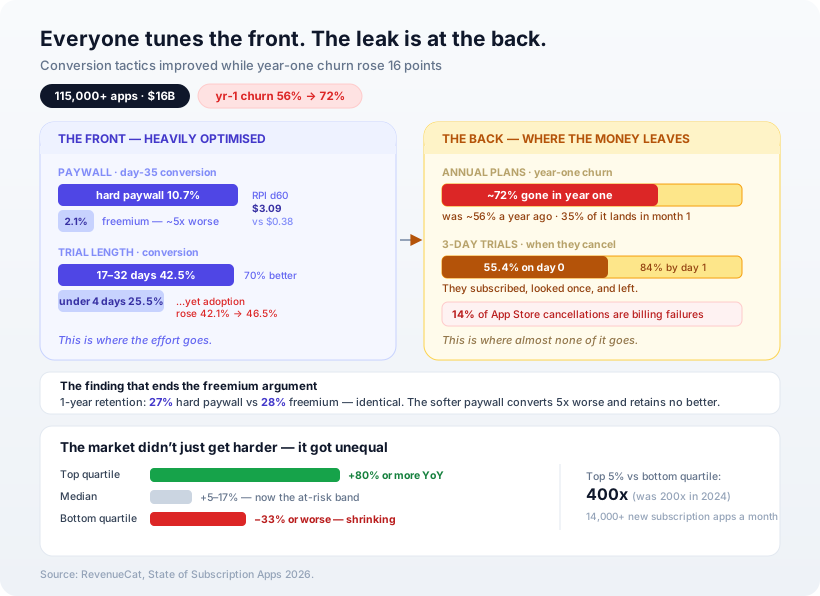
The subscription app market didn't just get more competitive last year — it got more unequal, and the middle started shrinking. The bottom quartile of apps lost more than a third of their revenue, year-one churn on annual plans jumped from 56% to 72%, and the distance between the top 5% and the bottom quarter widened from 200x to 400x. Subscription stopped being a pricing decision you make at launch and became an operating commitment to run retention forever — which is the part almost nobody staffs.
Why this matters now
The numbers come from RevenueCat's State of Subscription Apps 2026, which covers 115,000+ apps and $16 billion in revenue — the largest public dataset on this question, and big enough that the distribution matters more than the averages.
- The median app is no longer safely growing. The top quartile grew 80%+ year on year while the bottom quartile declined by 33% or more — a 113-point spread between the halves of the market. Median growth in the 5–17% band is now characterised as at-risk rather than healthy.
- The gap doubled. The top 5% of apps now earn roughly 400x what the bottom quartile does, up from 200x in 2024.
- Year-one churn on annual plans went from ~56% to ~72% in a single year, with 35% of annual cancellations landing in month one. An annual subscriber is no longer a year of revenue you can plan against.
- Meanwhile 14,000+ new subscription apps launch every month, so the denominator keeps growing.
Read those together and the story isn't "subscriptions are saturated." It's that the returns concentrated sharply, and the median moved from slow growth to slow decline.
The mechanism: everyone tunes the front, the leak is at the back
Almost all published subscription advice is about conversion — paywall design, trial length, onboarding, price testing. That work is real and the data supports it: a hard paywall converts at 10.7% by day 35 against freemium's 2.1%, and produces $3.09 revenue per install by day 60 versus $0.38.
But look at what happened over the same period. Conversion tactics improved. Retention collapsed. Year-one churn went up 16 points while the industry was busy A/B testing paywall copy.
There's a finding buried in the same dataset that reframes the whole debate: one-year retention is 27% for hard paywalls and 28% for freemium. Essentially identical. The long-standing argument for freemium — that a softer entry builds a larger, more loyal base you monetise later — doesn't survive the data. The soft paywall converts five times worse and retains the same.
Acquisition is a project. Retention is a payroll line. Teams that price like the first and staff like neither are the bottom quartile.
The clearest illustration is the trial data, because it shows the industry actively moving the wrong way. Trials of 17–32 days convert at 42.5%; trials under four days convert at 25.5% — a 70% advantage for the longer window. And yet the share of apps using sub-four-day trials rose from 42.1% to 46.5%. Teams are migrating toward the option that measurably converts worse, presumably chasing faster feedback, and paying for it in conversion.
On those short trials, 55.4% of cancellations happen on day zero and 84% by day one — people subscribe, look, and leave almost immediately. That's not a pricing problem. It's a product-value problem showing up in a billing metric.
What to do about it
- Decide whether you can staff retention before you pick the model. Subscription revenue requires someone whose job is churn — lifecycle messaging, win-back, dunning, re-engagement. If nobody owns that, you've chosen a model you can't operate.
- Fix billing failures first — it's the cheapest retention you'll ever buy. 14% of App Store cancellations are billing failures, and those users didn't decide to leave. Grace periods, retry logic, and card-update prompts recover revenue from people who already wanted to stay.
- Stop shortening trials. If you're on a sub-four-day trial because it felt tighter, the data says you're leaving roughly 17 points of conversion on the table.
- Treat day-zero trial cancellation as a product signal, not a funnel metric. When most cancellations happen before the user has done anything, the paywall isn't the problem — the first session is.
- Measure against the distribution, not the median. "We're growing 10%" reads fine until you notice that band is now the at-risk zone.
- Consider whether recurring value actually exists. Some products genuinely deliver something every month. Others deliver a lot once. Charging monthly for the second kind is how you end up with 72% year-one churn and blame the market.
Our opinion
Subscription is an operating model wearing the costume of a pricing decision. It gets chosen in week one, in a spreadsheet, because the LTV maths look better than a one-time purchase. What that spreadsheet doesn't encode is that the model obliges you to keep earning the same customer indefinitely, and a two-person team shipping features has no capacity for that.
We'd put it plainly: for a small team building a focused tool, a one-time purchase is often the more honest model and the more defensible business. You are paid for the value you delivered, the customer never has to re-decide, and you're not running a retention operation you don't have staff for. Most of our portfolio is priced that way — not out of principle, but because the maths works better at our size. We do run one subscription, on a product where the value genuinely recurs, and it's a materially different amount of ongoing work.
The counter-argument deserves its due: for products with real ongoing cost or ongoing value — sync, storage, a content library, anything with a server bill per active user — subscription isn't just defensible, it's the only model that doesn't eventually break. The test isn't philosophical. It's whether your costs and your value both recur. If only your costs do, you have a pricing problem. If only your value does, you're leaving money on the table. If neither does, charge once.
How Ashvara helps
We help teams pick the model before it's expensive to change — which usually means an honest conversation about whether the value recurs, and whether anyone will own retention if it does. That's part of the same scoping work as deciding what actually goes in v1, and it's the reasoning behind where pay-once fits.
It's core to our MVP development practice, and it's a much cheaper conversation to have before launch than after a year of 72% churn. If you're weighing subscription against pay-once, tell us what you're building and we'll work through the maths with you.
Sources: RevenueCat, "State of Subscription Apps 2026" — 115,000+ apps and $16B in revenue; growth by quartile, paywall and trial conversion, annual churn, and billing-failure rates (revenuecat.com).